
Intelligent Cockpit Design through Coordination of Driving Tasks and Attentional Resources
DOI:
https://doi.org/10.64509/jdi.14.165Keywords:
Intelligent Design, Intelligent Cockpit, Scenario-Based Design, Attentional Resources, Human–Automation Interaction, System InitiativeAbstract
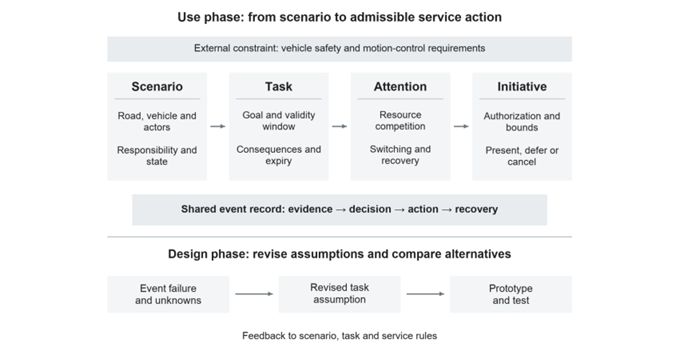
The value of an intelligent cockpit depends on the fit between information, interaction modalities, and driving tasks. Drawing on an integrative analysis of design research, scenario-based design, attention, and human–automation interaction, this paper proposes a scenario–task–attention–initiative framework. Scenarios are translated into tasks with explicit responsibility, timing, and consequence constraints. Modality selection is treated as a resource-competition problem, while proactive system behavior is bounded by uncertainty, authorization, and recovery conditions. Event-level evidence from use feeds back into problem framing and AI-assisted design. The contribution is a conceptual model operationalized as an analytical design method: an event record links task constraints, admissible service actions, and revisions to design assumptions. Comparisons with four theoretical foundations identify inherited mechanisms and proposed relationships. Worked scenario and task cards, a qualitative decision procedure, and four operationalized propositions make the synthesis inspectable. No driving experiment was conducted; its incremental benefits, classification reliability, and safety implications remain to be empirically tested.
Downloads
References
[1] Li, Y., Qi, L., Hao, R.: Current status and development of user‑, technology‑, and scenario‑driven automotive intelligent design methods (In Chinese). Art & Design Research 2024(6), 117–123 (2024)
[2] Figoli, F.A., Bruggeman, R., Rampino, L., Ciuccarelli, P.: AI‑against‑design map: A systematic review of 20 years of AI‑focused studies in design research. Design Studies 96, 101279 (2025)
[3] Dorst, K., Cross, N.: Creativity in the design process: Co‑evolution of problem–solution. Design Studies 22(5), 425–437 (2001)
[4] Dorst, K.: The core of ’design thinking’ and its application. Design Studies 32(6), 521–532 (2011)
[5] Wickens, C.D.: Multiple resources and mental workload. Human Factors: The Journal of the Human Factors and Ergonomics Society 50(3), 449–455 (2008)
[6] Endsley, M.R.: Toward a theory of situation awareness in dynamic systems. Human Factors: The Journal of the Human Factors and Ergonomics Society 37(1), 32–64 (1995)
[7] Bainbridge, L.: Ironies of automation. Automatica 19(6), 775–779 (1983)
[8] Torraco, R.J.: Writing integrative literature reviews: Guidelines and examples. Human Resource Development Review 4(3), 356–357 (2005)
[9] Snyder, H.: Literature review as a research methodology: An overview and guidelines. Journal of Business Research 104, 333–339 (2019)
[10] Page, M.J., McKenzie, J.E., Bossuyt, P.M., Boutron, I., Hoffmann, T.C., Mulrow, C.D., Shamseer, L., Tetzlaff, J.M., Akl, E.A., Brennan, S.E., et al.: The PRISMA 2020 statement: An updated guideline for reporting systematic reviews. BMJ 372, n71 (2021)
[11] Wu, Z., Ji, D., Yu, K., Zeng, X., Wu, D., Shidujaman, M.: AI creativity and the human‑AI co‑creation model. In proceedings of Human‑Computer Interaction. Theory, Methods and Tools, pp. 171–190 (2021)
[12] Luo, S., Zhang, D., Liang, C.: Collective‑intelligence innovation design in the age of artificial intelligence [In Chinese]. Art & Design Research 2024(2), 91–97 (2024)
[13] Kyriakidis, M., de Winter, J.C.F., Stanton, N., Bellet, T., van Arem, B., Brookhuis, K., Martens, M.H., Bengler, K., Andersson, J., Merat, N., et al.: A human factors perspective on automated driving. Theoretical Issues in Ergonomics Science 20(3), 223–249 (2019)
[14] Carroll, J.M.: Five reasons for scenario‑based design. Interacting with Computers 13(1), 43–60 (2000)
[15] Cao, J., Zhang, J., Zhang, L., Wang, X.: Psychological structure and effects of interaction naturalness [In Chinese]. Acta Psychologica Sinica 55(1), 55–65 (2023)
[16] Healey, J.A., Picard, R.W.: Detecting stress during real‑world driving tasks using physiological sensors. IEEE Transactions on Intelligent Transportation Systems 6(2), 156–166 (2005)
[17] Shahverdy, M., Fathy, M., Berangi, R., Sabokrou, M.: Driver behavior detection and classification using deep convolutional neural networks. Expert Systems with Applications 149, 113240 (2020)
[18] Oulasvirta, A., Kurvinen, E., Kankainen, T.: Understanding contexts by being there: Case studies in bodystorming. Personal and Ubiquitous Computing 7, 125–134 (2003)
[19] Pink, S.: Doing Sensory Ethnography, 2nd edn. SAGE, London, UK (2015)
[20] Sanders, E.B.‑N., Stappers, P.J.: Probes, toolkits and prototypes: Three approaches to making in codesigning. CoDesign 10(1), 5–14 (2014)
[21] Regan, M.A., Hallett, C., Gordon, C.P.: Driver distraction and driver inattention: Definition, relationship and taxonomy. Accident Analysis & Prevention 43(5), 1771–1781 (2011)
[22] Klauer, S.G., Guo, F., Simons‑Morton, B.G., Ouimet, M.C., Lee, S.E., Dingus, T.A.: Distracted driving and risk of road crashes among novice and experienced drivers. New England Journal of Medicine 370(1), 54–59 (2014)
[23] Dingus, T.A., Guo, F., Lee, S., Antin, J.F., Perez, M., Buchanan‑King, M., Hankey, J.: Driver crash risk factors and prevalence evaluation using naturalistic driving data. Proceedings of the National Academy of Sciences 113(10), 2636–2641 (2016)
[24] Schnelle‑Walka, D., McGee, D.R., Pfleging, B.: Multimodal interaction in automotive applications. Journal on Multimodal User Interfaces 13(2), 53–54 (2019)
[25] Oviatt, S.: Ten myths of multimodal interaction. Communications of the ACM 42(11), 74–81 (1999)
[26] Strayer, D.L., Johnston, W.A.: Driven to distraction: Dual‑task studies of simulated driving and conversing on a cellular telephone. Psychological Science 12(6), 462–466 (2001)
[27] Horrey, W.J., Wickens, C.D.: Examining the impact of cell phone conversations on driving using meta‑analytic techniques. Human Factors: The Journal of the Human Factors and Ergonomics Society 48(1), 196–205 (2006)
[28] Caird, J.K., Willness, C.R., Steel, P., Scialfa, C.: A meta‑analysis of the effects of cell phones on driver performance. Accident Analysis & Prevention 40(4), 1282–1293 (2008)
[29] Caird, J.K., Johnston, K.A., Willness, C.R., Asbridge, M., Steel, P.: A meta‑analysis of the effects of texting on driving. Accident Analysis & Prevention 71, 311–318 (2014)
[30] Caird, J.K., Simmons, S.M., Wiley, K., Johnston, K.A., Horrey, W.J.: Does talking on a cell phone, with a passenger, or dialling affect driving performance? An updated systematic review and meta‑analysis of experimental studies. Human Factors: The Journal of the Human Factors and Ergonomics Society 60(1), 101–133 (2018)
[31] Strayer, D.L., Drews, F.A., Johnston, W.A.: Cell phone‑induced failures of visual attention during simulated driving. Journal of Experimental Psychology: Applied 9(1), 23–32 (2003)
[32] Lee, J.D., Caven, B., Haake, S., Brown, T.L.: Speech‑based interaction with in‑vehicle computers: The effect of speech‑based e‑mail on drivers’ attention to the roadway. Human Factors: The Journal of the Human Factors and Ergonomics Society 43(4), 631–640 (2001)
[33] Spence, C., Ho, C.: Multisensory warning signals for event perception and safe driving. Theoretical Issues in Ergonomics Science 9(6), 523–554 (2008)
[34] Ho, C., Reed, N., Spence, C.: Multisensory in‑car warning signals for collision avoidance. Human Factors: The Journal of the Human Factors and Ergonomics Society 49(6), 1107–1114 (2007)
[35] Ho, C., Santangelo, V., Spence, C.: Multisensory warning signals: When spatial correspondence matters. Experimental Brain Research 195(2), 261–272 (2009)
[36] Parasuraman, R., Sheridan, T.B., Wickens, C.D.: A model for types and levels of human interaction with automation. IEEE Transactions on Systems, Man, and Cybernetics—Part A: Systems and Humans 30(3), 286–297 (2000)
[37] Parasuraman, R., Riley, V.: Humans and automation: Use, misuse, disuse, abuse. Human Factors: The Journal of the Human Factors and Ergonomics Society 39(2), 230–253 (1997)
[38] Lee, J.D., See, K.A.: Trust in automation: Designing for appropriate reliance. Human Factors: The Journal of the Human Factors and Ergonomics Society 46(1), 50–80 (2004)
[39] Hancock, P.A., Billings, D.R., Schaefer, K.E., Chen, J.Y.C., de Visser, E.J., Parasuraman, R.: A meta‑analysis of factors affecting trust in human‑robot interaction. Human Factors: The Journal of the Human Factors and Ergonomics Society 53(5), 517–527 (2011)
[40] Endsley, M.R., Kiris, E.O.: The out‑of‑the‑loop performance problem and level of control in automation. Human Factors: The Journal of the Human Factors and Ergonomics Society 37(2), 381–394 (1995)
[41] Sarter, N.B., Woods, D.D.: How in the world did we ever get into that mode? Mode error and awareness in supervisory control. Human Factors: The Journal of the Human Factors and Ergonomics Society 37(1), 5–19 (1995)
[42] Hoff, K.A., Bashir, M.: Trust in automation: Integrating empirical evidence on factors that influence trust. Human Factors: The Journal of the Human Factors and Ergonomics Society 57(3), 407–434 (2015)
[43] Schaefer, K.E., Chen, J.Y.C., Szalma, J.L., Hancock, P.A.: A meta‑analysis of factors influencing the development of trust in automation: Implications for understanding autonomy in future systems. Human Factors: The Journal of the Human Factors and Ergonomics Society 58(3), 377–400 (2016)
[44] Körber, M., Baseler, E., Bengler, K.: Introduction matters: Manipulating trust in automation and reliance in automated driving. Applied Ergonomics 66, 18–31 (2018)
[45] Verberne, F.M.F., Ham, J., Midden, C.J.H.: Trust in smart systems: Sharing driving goals and giving information to increase trustworthiness and acceptability of smart systems in cars. Human Factors: The Journal of the Human Factors and Ergonomics Society 54(5), 799–810 (2012)
[46] Parasuraman, R., Manzey, D.H.: Complacency and bias in human use of automation: An attentional integration. Human Factors: The Journal of the Human Factors and Ergonomics Society 52(3), 381‑410 (2010)
[47] Noy, S., Zhang, W.: Experimental evidence on the productivity effects of generative artificial intelligence. Science 381(6654), 187‑192 (2023)
[48] Vaccaro, M., Almaatouq, A., Malone, T.: When combinations of humans and AI are useful: A systematic review and meta‑analysis. Nature Human Behaviour 8, 2293‑2303 (2024)
[49] Zhang, G., Raina, A., Cagan, J., McComb, C.: A cautionary tale about the impact of AI on human design teams. Design Studies 72, 100990 (2021)
[50] Doshi, A.R., Hauser, O.P.: Generative AI enhances individual creativity but reduces the collective diversity of novel content. Science Advances 10(28), eadn5290 (2024)
[51] Messeri, L., Crockett, M.J.: Artificial intelligence and illusions of understanding in scientific research. Nature 627, 49‑58 (2024)
[52] Buchanan, R.: Wicked problems in design thinking. Design Issues 8(2), 5‑21 (1992)
[53] Simon, H.A.: The Sciences of the Artificial, 3rd edn. MIT Press, Cambridge, MA, USA (1996)
[54] Cross, N.: Designerly Ways of Knowing, 1st edn. Springer London, London, UK (2006)
[55] Clark, A.: Supersizing the Mind: Embodiment, Action, and Cognitive Extension. Oxford University Press, New York, USA (2008)
[56] Paxion, J., Galy, E., Berthelon, C.: Mental workload and driving. Frontiers in Psychology 5, 1344 (2014)
[57] Warm, J.S., Parasuraman, R., Matthews, G.: Vigilance requires hard mental work and is stressful. Human Factors: The Journal of the Human Factors and Ergonomics Society 50(3), 433‑441 (2008)
[58] Charles, R.L., Nixon, J.: Measuring mental workload using physiological measures: A systematic review. Applied Ergonomics 74, 221‑232 (2019)
[59] Tao, D., Tan, H., Wang, H., Zhang, X., Qu, X., Zhang, T.: A systematic review of physiological measures of mental workload. International Journal of Environmental Research and Public Health 16(15), 2716 (2019)
[60] Horvitz, E.: Principles of mixed‑initiative user interfaces. In Proceedings of the SIGCHI Conference on Human Factors in Computing Systems, pp. 159‑166, (1999)
[61] Amershi, S., Weld, D., Vorvoreanu, M., Fourney, A., Nushi, B., Collisson, P., Suh, J., Iqbal, S., Bennett, P.N., Inkpen, K., et al.: Guidelines for human‑AI interaction. In Proceedings of the 2019 CHI Conference on Human Factors in Computing Systems, pp. 1‑13, (2019)
[62] Goodfellow, I., Bengio, Y., Courville, A.: Deep Learning. MIT Press, Cambridge, MA, USA (2016)
[63] Russell, S.J., Norvig, P.: Artificial Intelligence: A Modern Approach, 3rd edn. Pearson Education Limited, London, UK (2010)
[64] Beller, J., Heesen, M., Vollrath, M.: Improving the driver‑automation interaction: An approach using automation uncertainty. Human Factors: The Journal of the Human Factors and Ergonomics Society 55(6), 1130‑1141 (2013)
[65] Körber, M., Prasch, L., Bengler, K.: Why do I have to drive now? Post hoc explanations of takeover requests. Human Factors: The Journal of the Human Factors and Ergonomics Society 60(3), 305‑323 (2018)
[66] Norman, D.A.: The Design of Everyday Things, revised and expanded edition, Basic Books, New York, USA (2013)
[67] Molich, R., Nielsen, J.: Improving a human‑computer dialogue. Communications of the ACM 33(3), 338‑348 (1990)
[68] Calvo, R.A., Peters, D.: Positive Computing: Technology for Wellbeing and Human Potential. MIT Press, Cambridge, MA, USA (2014)
[69] Naujoks, F., Wiedemann, K., Schömig, N., Hergeth, S., Keinath, A.: Towards guidelines and verification methods for automated vehicle HMIs. Transportation Research Part F: Traffic Psychology and Behaviour 60, 121‑136 (2019)
[70] Eriksson, A., Stanton, N.A.: Takeover time in highly automated vehicles: Noncritical transitions to and from manual control. Human Factors: The Journal of the Human Factors and Ergonomics Society 59(4), 689‑705 (2017)
[71] Zhang, B., de Winter, J., Varotto, S., Happee, R., Martens, M.: Determinants of take‑over time from automated driving: A meta‑analysis of 129 studies. Transportation Research Part F: Traffic Psychology and Behaviour 64, 285‑307 (2019)
[72] Merat, N., Jamson, A.H., Lai, F.C.H., Daly, M., Carsten, O.M.J.: Transition to manual: Driver behaviour when resuming control from a highly automated vehicle. Transportation Research Part F: Traffic Psychology and Behaviour 27(Part B), 274‑282 (2014)
[73] Gold, C., Damböck, D., Lorenz, L., Bengler, K.: “Take over!” How long does it take to get the driver back into the loop? Proceedings of the Human Factors and Ergonomics Society Annual Meeting 57(1), 1938‑1942 (2013)
[74] de Winter, J.C.F., Happee, R., Martens, M.H., Stanton, N.A.: Effects of adaptive cruise control and highly automated driving on workload and situation awareness: A review of the empirical evidence. Transportation Research Part F: Traffic Psychology and Behaviour 27(Part B), 196‑217 (2014)
[75] Lu, Z., Happee, R., Cabrall, C.D., Kyriakidis, M., de Winter, J.C.: Human factors of transitions in automated driving: A general framework and literature survey. Transportation Research Part F: Traffic Psychology and Behaviour 43, 183‑198 (2016)
[76] McDonald, A.D., Alambeigi, H., Engström, J., Markkula, G., Vogelpohl, T., Dunne, J., Yuma, N.: Toward computational simulations of behavior during automated driving takeovers: A review of the empirical and modeling literatures. Human Factors: The Journal of the Human Factors and Ergonomics Society 61(4), 642‑688 (2019)
[77] Gold, C., Körber, M., Lechner, D., Bengler, K.: Taking over control from highly automated vehicles in complex traffic situations: The role of traffic density. Human Factors: The Journal of the Human Factors and Ergonomics Society 58(4), 642‑652 (2016)
[78] Braun, V., Clarke, V.: Using thematic analysis in psychology. Qualitative Research in Psychology 3, 77‑101 (2006)
[79] Hart, S.G., Staveland, L.E.: “Development of NASA‑TLX (Task Load Index): Results of empirical and theoretical research” in Human Mental Workload, volume 52 of Advances in Psychology, pp. 139‑183. North‑Holland (1988)
[80] Lakens, D.: Sample size justification. Collabra: Psychology 8(1), 33267 (2022)
[81] Lakens, D.: Calculating and reporting effect sizes to facilitate cumulative science: A practical primer for t‑tests and ANOVAs. Frontiers in Psychology 4, 863 (2013)
[82] Landis, J.R., Koch, G.G.: The measurement of observer agreement for categorical data. Biometrics 33(1), 159‑174 (1977)
Downloads
Published
Issue
Section
License
Copyright (c) 2026 Guanghong Xie (Author)

This work is licensed under a Creative Commons Attribution 4.0 International License.