
A Rule-Based Parametric Workflow for Tessellation-Based 3D-Printed Textile Textures: A Haptic-Relevant Design Exploration
DOI:
https://doi.org/10.64509/jdi.11.52Keywords:
Parametric Design, Rule-based Parametric Workffow, Computational Design, Digital Fabrication, 3D-Printed Textile Textures, Tessellation-based PatternsAbstract
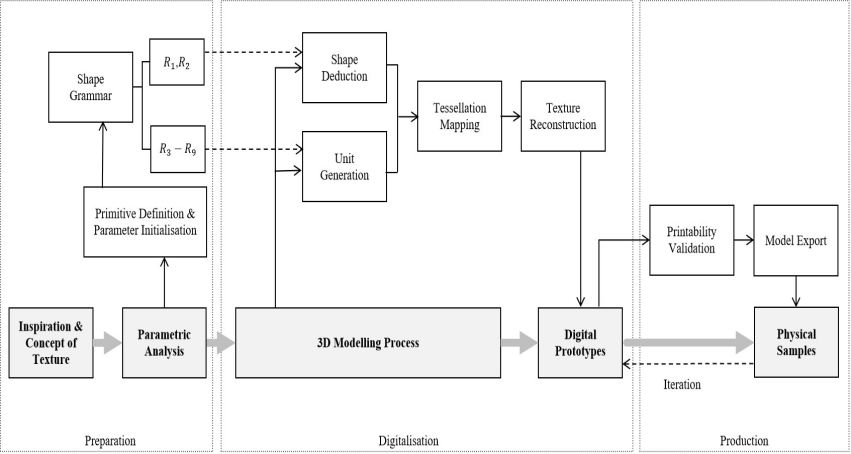
Quadrilateral-based continuous textile patterns are well suited to large-scale fabrication as rhythmic surface effects can be produced through repetition, translation and rotation. This paper presents a rule-based parametric design workflow for three-dimensional (3D)-printed textile textures based on tessellation patterns with continuous geometric properties that was developed through shape grammar principles and implemented in the Grasshopper visual programming environment. During testing, the workflow demonstrated how a square-based geometric primitive—defined here as a planar base unit with edge-to-edge continuity suitable for tessellation construction—can be systematically transformed into tessellated textile textures through parametric rules and form, forming a reproducible digital-to-physical pipeline from algorithmic generation to physical realisation. The square primitive was employed as an exemplar case due to its geometric clarity, while the underlying shape grammar rules and parametric operations were not restricted to a specific geometry and could have been extended to alternative planar primitives. The study focused on the integration of geometric rule definition, parametric variation and fabrication constraints within textile-integrated fused deposition modelling (FDM). Physical validation was therefore limited to printability, material feasibility and structural coherence using thermoplastic polyurethane (TPU) rather than empirical evaluation of tactile perception. Within this scope, haptic qualities were addressed as design-relevant dimensions embedded in geometric variation and fabrication parameters. Key parametric variables, which were defined through a set of explicitly structured geometric and fabrication parameters, provided a reproducible basis for future physical and perceptual evaluation. The contribution of this work lies in establishing a fabrication-aware, rule-based parametric workflow that bridges computational design logic and digital textile fabrication.
Downloads
References
[1] Woodbury, R.: Elements of Parametric Design. Routledge, Abingdon, UK (2010)
[2] Kolarevic, B.: Architecture in the Digital Age: Design and Manufacturing. Taylor & Francis, London, UK (2003). https://doi.org/10.4324/9780203634561
[3] Jabi, W.: Parametric Design for Architecture. Laurence King Publishing, London, UK (2013)
[4] Burry, J., Burry, M.: The New Mathematics of Architecture, pp. 156–162. Thames & Hudson, London, UK (2010)
[5] Schumacher, P.: Design parameters to parametric design in The Routledge Companion for Architecture, Design and Practice, pp. 3–20. Routledge, Abingdon, UK (2015)
[6] Ahlquist, S., Menges, A.: Computational Design Thinking. Wiley, Chichester, UK (2011)
[7] Svoboda, L., Novák, J., Kurilla, L., Zeman, J.: A framework for integrated design of algorithmic architectural forms. Advances in Engineering Software 72, 109–118 (2012). https://doi.org/10.1016/j.advengsoft.2013.05.006
[8] Martín-Mariscal, A., Fernández-Rodríguez, J.F., Picardo, A., Peralta, E.: Grasshopper Algorithmic Modelling: Parametric Design for Product Platform Customisation. Applied Sciences 15(11), 6243 (2025). https://doi.org/10.3390/app15116243
[9] Xiu, Y., Wan, Z.-K., Cao, W.: A constructive approach toward a parametric pattern-making model. Textile Research Journal 81(10), 979–991 (2011). https://doi.org/10.1177/0040517510388552
[10] Jeong, J., Park, H., Lee, Y., Kang, J., Chun, J.: Developing parametric design fashion products using 3D printing technology. Fashion and Textiles 8(1), 22 (2021). https://doi.org/10.1186/s40691-021-00247-8
[11] Sitotaw, D.B., Ahrendt, D.: Additive Manufacturing and Textiles-State-of-the-Art. Applied Sciences 10(15), 5033 (2020). https://doi.org/10.3390/app10155033
[12] Lin, M.: A brief introduction to body-oriented parametric design for 3D-printed fashion and textiles. TEXTILE 20(1), 55–73 (2021). https://doi.org/10.1080/14759756.2021.1955582
[13] Kočevar, T.N., Geršak, J., Dimitrovski, K.: 3D Printing on Textiles – Overview of Research on Adhesion Studies. Tekstilec 66(4), 265–280 (2023). https://doi.org/10.14502/tekstilec.66.2023055
[14] Grünbaum, B., Shephard, G.C.: Tilings and Patterns. W.H. Freeman, New York, USA (1987)
[15] Kaplan, C.S.: Introductory Tiling Theory for Computer Graphics. Springer, Cham, Switzerland (2009). https://doi.org/10.1007/978-3-031-79543-5
[16] Penrose, R.: The role of aesthetics in pure and applied mathematical research. Bulletin of Mathematical Analysis and Applications 10(7), 266–271 (1974)
[17] Aurenhammer, F.: Voronoi diagrams-A survey of a fundamental geometric data structure. ACM Computing Surveys 23(3), 345–405 (1991). https://doi.org/10.1145/116873.116880
[18] Chang, W.: Application of tessellation in architectural geometry design. E3S Web of Conferences 38, 03015 (2018). https://doi.org/10.1051/e3sconf/20183803015
[19] Spahiu, T., Lu, Q., Thei, M.M., Ehrmann, A.: Drape of composite structures made of textile and 3D-printed geometries. Machines 10(7), 587 (2022). https://doi.org/10.3390/machines10070587
[20] Pei, E., Shen, J., Watling, J.: Direct 3D printing of polymers onto textiles: Experimental studies and applications. Rapid Prototyping Journal 21(5), 556–571 (2015). http://doi.org/10.1108/RPJ-09-2014-0126
[21] Ferschin, P., Suter, G.: Integrated parametric design and production planning: a luminaire design case study. In Proceedings of the 11th Annual Symposium on Simulation for Architecture and Urban Design, pp. 1–8 (2020)
[22] Dillenburger, B., Hansmeyer, M.: Printing Architecture: Castles Made of Sand in Fabricate 2014: Negotiating Design & Making, pp. 92–97. UCL Press, London, UK (2014). https://doi.org/10.2307/j.ctt1tp3c5w.15
[23] Chang, H.-C.: Parametric design is used in the creation of 3D models with weaving characteristics. Journal of Computer and Communications 9, 112–127 (2021). https://doi.org/10.4236/jcc.2021.911008
[24] Norman, D. A.: Emotional Design: Why We Love (or Hate) Everyday Things. Basic Books, New York, USA (2004)
[25] Desmet, P., Hekkert, P.: Framework of Product Experience. International Journal of Design 1(1), 57–66 (2007)
[26] Kassab, L., Desmet, P., Porcelijn, R.: Calming garments for people with autism: A design framework for tactilebased emotional regulation. The Design Journal 24(2), 271–292 (2021)
[27] Haggström, M.: Emotional and Sensory Design of Textiles: A Human-Centred Approach. Textile Research Journal 91(9–10), 1104–1120 (2021)
[28] Stiny, G.: Introduction to shape and shape grammars. Environment and Planning B 7(3), 343–351 (1980)
[29] Stratasys Ltd.: 3D Printing Solutions – The professional’s guide to 3D printing. https://www.stratasys.com/uk/resources/ebooks/3d-printing-solutions/ Accessed 2025-11-08
[30] Ultimaker B.V.: Design for FFF 3D Printing: Maximize your success. https://ultimaker.com/learn/design-for-fff-3d-printing-maximize-your-success/ Accessed 2025-11-08
Downloads
Published
Issue
Section
License
Copyright (c) 2026 Authors

This work is licensed under a Creative Commons Attribution 4.0 International License.