
A User Preference Recommendation System for Industry 5.0 Based on DSD-Transformer
DOI:
https://doi.org/10.64509/jdi.11.53Keywords:
Industry 5.0, Internet of Things (IoT), Recommendation System, Collaborative Filtering, Transformer, Density-Sensitive DistanceAbstract
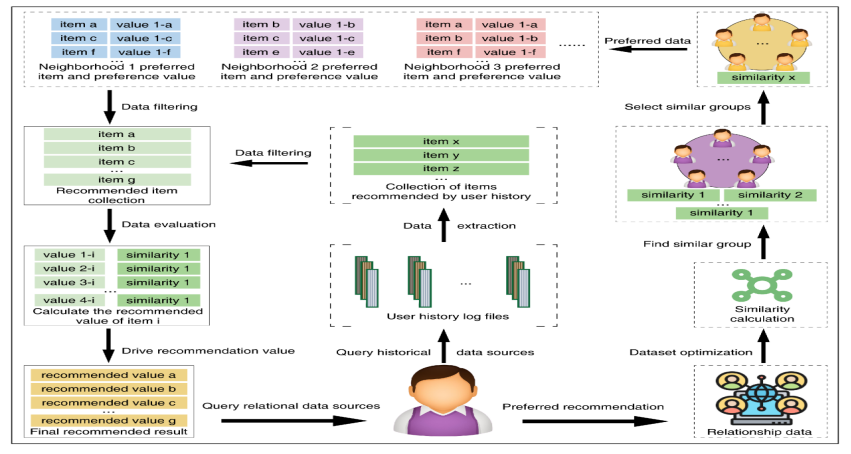
Industry 5.0, characterized by the deep integration of the Internet of Things (IoT), artificial intelligence (AI), digital twins, and edge computing, represents a new paradigm for intelligent manufacturing and human–machine collaboration. By enabling real-time interaction between physical and cyber-physical systems, Industry 5.0 fosters personalized, adaptive, and sustainable production environments. However, the growing diversity of industrial products and user requirements presents challenges in effectively matching industrial users with suitable design solutions or manufacturing resources. Recommendation systems, particularly those based on Collaborative Filtering (CF), have emerged as powerful tools to address this issue by leveraging user preferences and behavioral data. Nevertheless, traditional CF algorithms often encounter efficiency bottlenecks when processing the high-dimensional, heterogeneous, and dynamic data typical of Industry 5.0 environments.To overcome these limitations, this paper proposes a clustering-based CF algorithm that improves recommendation efficiency by incorporating industrial user relationship modeling. Furthermore, a Density-Sensitive Distance Transformer (DSD-Transformer) framework is developed to enhance clustering precision and recommendation accuracy. Experimental evaluations conducted on real industrial datasets demonstrate that the proposed model significantly outperforms existing methods in both prediction accuracy and computational efficiency, making it well suited for Industry 5.0-oriented intelligent recommendation and decision-support applications.
Downloads
References
[1] Awouda, A., Traini, E., Bruno, G., Chiabert, P.: IoT-Based Framework for Digital Twins in the industry 5.0 era. Sensors 24(2), 594 (2024). https://doi.org/10.3390/s24020594 DOI: https://doi.org/10.3390/s24020594
[2] Yang, J., Liu, Y., Morgan, P.L.: Human–machine interaction towards Industry 5.0: Human-centric smart manufacturing. Digital Engineering 2, 100013 (2024). https://doi.org/10.1016/j.dte.2024.100013 DOI: https://doi.org/10.1016/j.dte.2024.100013
[3] Ghobakhloo, M., Iranmanesh, M., Tseng, M.-L., Grybauskas, A., Stefanini, A., Amran, A.: Behind the definition of Industry 5.0: a systematic review of technologies, principles, components, and values. Journal of Industrial and Production Engineering 40(6), 432–447 (2023). https://doi.org/10.1080/21681015.2023.2216701 DOI: https://doi.org/10.1080/21681015.2023.2216701
[4] Xu, J., Sun, Q., Han, Q.-L., Tang, Y.: When embodied AI meets Industry 5.0: Human-centered smart manufacturing. IEEE/CAA Journal of Automatica Sinica 12(3), 485–501 (2025). https://doi.org/10.1109/JAS.2025.125327 DOI: https://doi.org/10.1109/JAS.2025.125327
[5] Shabur, M.A., Shahriar, A., Ara, M.A.: From automation to collaboration: exploring the impact of industry 5.0 on sustainable manufacturing. Discover sustainability 6(1), 341 (2025). https://doi.org/10.1007/s43621-025-01201-0 DOI: https://doi.org/10.1007/s43621-025-01201-0
[6] Ionescu, A.-M., Ionescu, A.-C.: Exploring the Future of Manufacturing: An Analysis of Industry 5.0’s Priorities and Perspectives. Sustainability 17(17), 7842 (2025). https://doi.org/10.3390/su17177842 DOI: https://doi.org/10.3390/su17177842
[7] Yassaie, N., Al-Dabbagh, A.W.: A recommender system for human operators in industrial automation. Control Engineering Practice 147, 105910 (2024). https://doi.org/10.1016/j.conengprac.2024.105910 DOI: https://doi.org/10.1016/j.conengprac.2024.105910
[8] Gunathilaka, T.M.A.U., Manage, P.D., Zhang, J., Li, Y., Kelly, W.: Addressing sparse data challenges in recommendation systems: A systematic review of rating estimation using sparse rating data and profile enrichment techniques. Intelligent Systems with Applications 25, 200474 (2025). https://doi.org/10.1016/j.iswa.2024.200474 DOI: https://doi.org/10.1016/j.iswa.2024.200474
[9] Kuźelewska, U.: Selection of clusters based on internal indices in multi-clustering collaborative filtering recommender system. International Journal of Electronics and Telecommunications 70(1), 103–114 (2024) DOI: https://doi.org/10.24425/ijet.2024.149520
[10] Krishnan, D., Singh, S., Sugumaran, V.: Explainable AI for zero-day attack detection in IoT networks using attention fusion model. Discover Internet of Things 5(1), 83 (2025). https://doi.org/10.1007/s43926-025-00184-8 DOI: https://doi.org/10.1007/s43926-025-00184-8
[11] Xu, B., Zhao, J., Wang, B., He, G.: Detection of zero-day attacks via sample augmentation for the Internet of Vehicles. Vehicular Communications 52, 100887 (2025). https://doi.org/10.1016/j.vehcom.2025.100887 DOI: https://doi.org/10.1016/j.vehcom.2025.100887
[12] He, G., He, T., Chen, R., Xu, B., Zhu, H., Zhang, L., Guo, N.: Multi-Device Collaborative Authentication for Internet of Things. IEEE Internet of Things Journal 12(14), 27753–27768 (2025). https://doi.org/10.1109/JIOT.2025.3563530 DOI: https://doi.org/10.1109/JIOT.2025.3563530
[13] Almadhor, A., Alsubai, S., Kryvinska, N., Hejaili, A.A., Ayari, M., Bouallegue, B., Abbas, S.: Evaluating large transformer models for anomaly detection of resource-constrained IoT devices for intrusion detection system. Scientific Reports 15(1), 37972 (2025). https://doi.org/10.1038/s41598-025-21826-5 DOI: https://doi.org/10.1038/s41598-025-21826-5
[14] Zheng, Y., Zhou, X.: Modeling multi-factor user preferences based on transformer for next point of interest recommendation. Expert Systems with Applications 255, 124894 (2024). https://doi.org/10.1016/j.eswa.2024.124894 DOI: https://doi.org/10.1016/j.eswa.2024.124894
[15] Langås, E.F., Zafar, M.H., Sanfilippo, F.: Exploring the synergy of human-robot teaming, digital twins, and machine learning in industry 5.0: A step towards sustainable manufacturing. Journal of Intelligent Manufacturing, 1–24 (2025). https://doi.org/10.1007/s10845-025-02580-x DOI: https://doi.org/10.1007/s10845-025-02580-x
[16] Alves, J., Lima, T.M., Gaspar, P.D.: Is industry 5.0 a human-centred approach? A systematic review. Processes 11(1), 193 (2023). https://doi.org/10.3390/pr11010193 DOI: https://doi.org/10.3390/pr11010193
[17] Islam, M.T., Sepanloo, K., Woo, S., Woo, S.H., Son, Y.-J.: A review of the industry 4.0 to 5.0 transition: exploring the intersection, challenges, and opportunities of technology and human–machine collaboration. Machines 13(4), 267 (2025). https://doi.org/10.3390/machines13040267 DOI: https://doi.org/10.3390/machines13040267
[18] Domínguez, L.G.I.: Digital Twins in Industry 5.0–a systematic literatura review. European Public & Social Innovation Review 9, 1–21 (2024). https://doi.org/10.31637/epsir-2024-641 DOI: https://doi.org/10.31637/epsir-2024-641
[19] Buri, Z., T. Kiss, J.: Digitalisation in the Context of Industry 4.0 and Industry 5.0: A Bibliometric Literature Review and Visualisation. Applied System Innovation 8(5), 137 (2025). https://doi.org/10.3390/asi8050137 DOI: https://doi.org/10.3390/asi8050137
[20] He, X., Liu, Q., Jung, S.: The impact of recommendation system on user satisfaction: A moderated mediation approach. Journal of Theoretical and Applied Electronic Commerce Research 19(1), 448–466 (2024). https://doi.org/10.3390/jtaer19010024 DOI: https://doi.org/10.3390/jtaer19010024
[21] Vassøy, B., Langseth, H.: Consumer-side fairness in recommender systems: a systematic survey of methods and evaluation. Artificial Intelligence Review 57(4), 101 (2024). https://doi.org/10.1007/s10462-023-10663-5 DOI: https://doi.org/10.1007/s10462-023-10663-5
[22] Zhang, S., Yang, W., Xu, S., Zhang, W.: A hybrid social network-based collaborative filtering method for personalized manufacturing service recommendation. International Journal of Computers Communications & Control 12(5), 728–740 (2017). https://doi.org/10.15837/ijccc.2017.5.2930 DOI: https://doi.org/10.15837/ijccc.2017.5.2930
[23] McPherson, M., Smith-Lovin, L., Cook, J.M.: Birds of a feather: Homophily in social networks. Annual review of sociology 27(1), 415–444 (2001). https://doi.org/10.3410/f.725356294.793504070 DOI: https://doi.org/10.1146/annurev.soc.27.1.415
[24] Dascalu, M.-I., Bodea, C.-N., Mihailescu, M.N., Tanase, E.A., Pablos, P.: Educational recommender systems and their application in lifelong learning. Behaviour & information technology 35(4), 290–297 (2016). https://doi.org/10.1080/0144929X.2015.1128977 DOI: https://doi.org/10.1080/0144929X.2015.1128977
[25] Souabi, S., Retbi, A., Idrissi, M.K.I.K., Bennani, S.: Recommendation systems on e-learning and social learning: A systematic review. Electronic Journal of E-Learning 19(5), 432–451 (2021). https://doi.org/10.34190/ejel.19.5.2482 DOI: https://doi.org/10.34190/ejel.19.5.2482
[26] Li, C.: A Personalized Product Recommendation System for E-Commerce Platforms Based on Artificial Intelligence and Image Processing Technologies. Traitement du Signal 41(6) (2024). https://doi.org/2961-2971 DOI: https://doi.org/10.18280/ts.410615
[27] Chang, C.-Y., Tu, C.-A., Huang, W.-L.: Developing a recommendation model for the smart factory system. Applied Sciences 11(18), 8606 (2021). https://doi.org/10.3390/app11188606 DOI: https://doi.org/10.3390/app11188606
[28] Lops, P., Gemmis, M., Semeraro, G.: Content-based Recommender Systems: State of the Art and Trends in Recommender Systems Handbook, pp. 73–105. Springer, Boston, MA, USA (2011). https://doi.org/10.1007/978-0-387-85820-3_3 DOI: https://doi.org/10.1007/978-0-387-85820-3_3
[29] Schafer, J.B., Frankowski, D., Herlocker, J., Sen, S.: Collaborative filtering recommender systems in The Adaptive Web. Lecture Notes in Computer Science, pp. 291–324. Springer, Berlin, Heidelberg, Germany (2007). https://doi.org/10.1007/978-3-540-72079-9_9 DOI: https://doi.org/10.1007/978-3-540-72079-9_9
[30] Su, X., Khoshgoftaar, T.M.: A survey of collaborative filtering techniques. Advances in artificial intelligence 2009(1), 421425 (2009). https://doi.org/10.1155/2009/421425 DOI: https://doi.org/10.1155/2009/421425
[31] Sun, F., Liu, J., Wu, J., Pei, C., Lin, X., Ou, W., Jiang, P.: BERT4Rec: Sequential recommendation with bidirectional encoder representations from transformer. In Proceedings of the 28th ACM International Conference on Information and Knowledge Management, pp. 1441–1450 (2019). https://doi.org/10.1145/3357384.3357895 DOI: https://doi.org/10.1145/3357384.3357895
[32] Pei, C., Zhang, Y., Zhang, Y., Sun, F., Lin, X., Sun, H., Wu, J., Jiang, P., Ge, J., Ou, W, et al.: Personalized reranking for recommendation. In Proceedings of the 13th ACM Conference on Recommender Systems, pp. 3–11 (2019). https://doi.org/10.1145/3298689.3347000 DOI: https://doi.org/10.1145/3298689.3347000
[33] Wu, L., Li, S., Hsieh, C.-J., Sharpnack, J.: SSE-PT: Sequential recommendation via personalized transformer. In Proceedings of the 14th ACM Conference on Recommender Systems, pp. 328–337 (2020). https://doi.org/10.1145/3383313.3412258 DOI: https://doi.org/10.1145/3383313.3412258
[34] Heidari, M., Rafatirad, S.: Using transfer learning approach to implement convolutional neural network model to recommend airline tickets by using online reviews. In 2020 15th International Workshop on Semantic and Social Media Adaptation and Personalization (SMA), pp. 1–6 (2020). https://doi.org/10.1109/SMAP49528.2020.9248443 DOI: https://doi.org/10.1109/SMAP49528.2020.9248443
[35] Gheewala, S., Xu, S., Yeom, S.: In-depth survey: deep learning in recommender systems-exploring prediction and ranking models, datasets, feature analysis, and emerging trends. Neural Computing and Applications 37, 10875–10947 (2025). https://doi.org/10.1007/s00521-024-10866-z DOI: https://doi.org/10.1007/s00521-024-10866-z
[36] Álvarez-Sánchez, A., Jiménez-Bravo, D.M., Moreno-García, M.N., García González, S., Cruz García, D.: Leveraging Visual Side Information in Recommender Systems via Vision Transformer Architectures. Electronics 14(17), 3550 (2025). https://doi.org/10.3390/electronics14173550 DOI: https://doi.org/10.3390/electronics14173550
[37] Kumar, J.N., G, M.S.: Efficient Recommender Systems via Co-Clustering-Based Collaborative Filtering. Informatica 49(23), 61–76 (2025). https://doi.org/10.31449/inf.v49i23.7156 DOI: https://doi.org/10.31449/inf.v49i23.7156
[38] Nilashi, M., Ibrahim, O., Bagherifard, K.: A recommender system based on collaborative filtering using ontology and dimensionality reduction techniques. Expert Systems with Applications 92, 507–520 (2018). https://doi.org/10.1016/j.eswa.2017.09.058 DOI: https://doi.org/10.1016/j.eswa.2017.09.058
[39] Tao, X., Wang, R., Chang, R., Li, C., Liu, R., Zou, J.: Spectral clustering algorithm using density-sensitive distance measure with global and local consistencies. Knowledge-Based Systems 170, 26–42 (2019). https://doi.org/10.1016/j.knosys.2019.01.026 DOI: https://doi.org/10.1016/j.knosys.2019.01.026
[40] Erisoglu, M., Calis, N., Sakallioglu, S.: A new algorithm for initial cluster centers in k-means algorithm. Pattern Recognition Letters 32(14), 1701–1705 (2011). https://doi.org/10.1016/j.patrec.2011.07.011 DOI: https://doi.org/10.1016/j.patrec.2011.07.011
[41] Mnih, A., Salakhutdinov, R.R.: Probabilistic matrix factorization. In Proceedings of the 21st International Conference on Neural Information Processing Systems, pp. 1257–1264 (2007)
[42] Salakhutdinov, R., Mnih, A.: Bayesian probabilistic matrix factorization using Markov chain Monte Carlo. In Proceedings of the 25th International Conference on Machine Learning, pp. 880–887 (2008). https://doi.org/10.1145/1390156.1390267 DOI: https://doi.org/10.1145/1390156.1390267
[43] Koren, Y.: Factorization meets the neighborhood: a multifaceted collaborative filtering model. In Proceedings of the 14th ACM SIGKDD International Conference on Knowledge Discovery and Data Mining, pp. 426–434 (2008). https://doi.org/10.1145/1401890.1401944 DOI: https://doi.org/10.1145/1401890.1401944
[44] Chen, B.-J., Yang, D.-N.: User recommendation in social metaverse with VR. In Proceedings of the 31st ACM International Conference on Information & Knowledge Management, pp. 148–158 (2022). https://doi.org/10.1145/3511808.3557487 DOI: https://doi.org/10.1145/3511808.3557487
Downloads
Published
Issue
Section
License
Copyright (c) 2026 Authors

This work is licensed under a Creative Commons Attribution 4.0 International License.