
Design a Driver Fatigue Intelligent Monitoring Cap Based on the Fusion of EEG and Blink Signals
DOI:
https://doi.org/10.64509/jdi.12.78Keywords:
Intelligent Wearable Monitoring, Driving Fatigue, EEG, Blink Signal, Cap Structure DesignAbstract
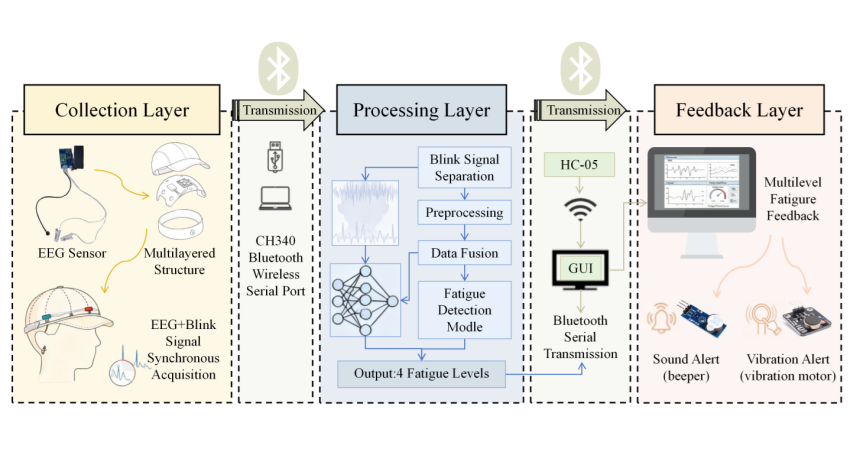
This study proposes a hat-based wearable intelligent monitoring system for driving fatigue, aiming to address the limitations of traditional wristband or helmet-style devices, such as difficulties in accurately reflecting fatigue levels, unstable signal acquisition, and insufficient comfort. From the perspective of apparel engineering, a modular hat design scheme was developed. By optimizing the inner structure, pressure distribution, and electrode attachment method of the hat, stable acquisition of electroencephalogram (EEG) and blink signals in driving scenarios was achieved. On this basis, a monitoring and feedback platform was constructed, incorporating a dynamic threshold blink detection method and an improved Long Short-Term Memory (LSTM) fusion model, the experimental results show that the selected brain-computer interface and blinking fusion method achieves an accuracy rate of over 92% in identifying different stages of driving fatigue. Finally, the monitoring system was tested using real driving data to evaluate its performance in various aspects such as signal acquisition, fatigue detection, grading feedback, and subjective wearing experience. This verified the practical application potential of the designed intelligent monitoring cap in monitoring driving fatigue.
Downloads
References
[1] Shekari Soleimanloo, S., Wilkinson, V.E., Cori, J.M.: Eye-Blink parameters detect on-road track-driving impairment following severe sleep deprivation. Journal of Clinical Sleep Medicine 15(9), 1271-1284 (2019). https://doi.org/10.5664/jcsm.7918
[2] Li, G., Li, B., Wang, G., Zhang, J., Wang, J.: A new method for human mental fatigue detection with several EEG channels. Journal of Medical and Biological Engineering 37(2), 240-247 (2017). https://doi.org/10.1007/s40846-017-0224-6
[3] Shahid, A., Wilkinson, K., Marcu, S., Shapiro, C.: Stanford Sleepiness Scale in STOP, THAT and One Hundred Other Sleep Scales. Springer, New York, USA (2011). https://doi.org/10.1007/978-1-4419-9893-4_91
[4] Torrance, G., Feeny, D., Furlong, W.: Visual analog scales: do they have a role in the measurement of preferences for health states? Medical Decision Making 21(4), 329-334 (2001). https://doi.org/10.1177/0272989x0102100408
[5] Shahid, A., Wilkinson, K., Marcu, S., Shapiro, C.: Karolinska Sleepiness Scale in STOP, THAT and One Hundred Other Sleep Scales. Springer, New York, USA (2011). https://doi.org/10.1007/978-1-4419-9893-4_47
[6] Xu, C., Pei, S.J., Wang, X.: Individualized driving fatigue detection based on non-invasive measurement indicators. China Journal of Highway and Transport 29(10), 118-125 (2016). https://doi.org/10.19721/j.cnki.1001-7372.2016.10.011
[7] Lee, K., Hyun, S.A., Oah, S.: Detecting driver fatigue by steering wheel grip force. International Journal of Contents 12(1), 44-48 (2016). https://doi.org/10.5392/IJoC.2016.12.1.044
[8] Li, Z., Li, S.E., Li, R., Cheng, B., Shi, J.: Online Detection of Driver Fatigue Using Steering Wheel Angles for Real Driving Conditions. Sensors 17(3), 495 (2017). https://doi.org/10.3390/s17030495
[9] Barbato, G., Ficca, G., Muscettola, G., Fichele, M., Beatrice, M., Rinaldi, F.: Diurnal variation in spontaneous eye-blink rate. Psychiatry Research 93(2), 145-151 (2000). https://doi.org/10.1016/S0165-1781(00)00108-6
[10] Zhao, G., He, Y., Yang, H.: Research on fatigue detection based on visual features. IET Image Processing 16(4), 1044-1053 (2022). https://doi.org/10.1049/ipr2.12207
[11] Mbouna, R.O., Kong, S.G., Chun, M.G.: Visual analysis of eye state and head pose for driver alertness monitoring. IEEE Transactions on Intelligent Transportation Systems 14(3), 1462-1469 (2013). https://doi.org/10.1109/TITS.2013.2262098
[12] Chang, R.C., Wang, C.Y., Chen, W.T., Chiu, C.D.: Drowsiness Detection System Based on PERCLOS and Facial Physiological Signal. Sensors 22(14), 5380 (2022). https://doi.org/10.3390/s22145380
[13] Xu, L.M.: Design of a driving fatigue detection system based on improved PERCLOS. Modern Electronic Technology 46(22), 41-45 (2023). https://doi.org/10.16652/j.issn.1004-373x.2023.22.008
[14] Cheng, Z., Yang, F.: Fatigue monitoring method for power dispatchers based on eyeball openness. Changjiang Information & Communications 37(3), 46-48 (2024)
[15] Arefnezhad, S., Eichberger, A., Frühwirth, M., Kaufmann, C., Moser, M., Koglbauer, I.V.: Driver monitoring of automated vehicles by classification of driver drowsiness using a deep convolutional neural network 480 (2022). https://doi.org/10.3390/en15020480
[16] Piotrow, Z., Szypulska, M.: Classification of falling asleep states using HRV analysis. Biocybernetics and Biomedical Engineering 37(2), 290-301 (2017). https://doi.org/10.1016/j.bbe.2017.02.003
[17] Sun, J., Liu, G., Sun, Y., Lin, K., Zhou, Z., Cai, J.: Application of surface electromyography in exercise fatigue: a review. Frontiers in Systems Neuroscience 16, 893275 (2022). https://doi.org/10.3389/fnsys.2022.893275
[18] Yu, N., Luo, X.M., Shu, Z.R.: Driver fatigue state discrimination method based on leg sEMG. Automotive Engineering 47(5), 951-962 (2025). https://doi.org/10.19562/j.chinasae.qcgc.2025.05.015
[19] Lee, B.G., Lee, B.L., Chung, W.Y.: Wristband-type driver vigilance monitoring system using smartwatch. IEEE Sensors Journal 15(11), 5624-5633 (2015). https://doi.org/10.1109/JSEN.2015.2447012
[20] Wang, B.S., Wu, X.C., Hu, X.Y.: Fatigue detection system based on single-channel EEG. Computer Science 47(5), 225-229 (2020)
[21] Kar, S., Bhagat, M., Routray, A.: EEG signal analysis for the assessment and quantification of driver's fatigue. Transportation Research Part F: Traffic Psychology and Behaviour 13(5), 297-306 (2010). https://doi.org/10.1016/j.trf.2010.06.006
[22] Agrawal, S., Peeta, S., Benedyk, I.: Evaluating the cognitive and psychological effects of real-time auditory travel information on drivers using EEG. Behaviour & Information Technology 42(10), 1617-1639 (2023). https://doi.org/10.1080/0144929X.2022.2093273
[23] Wang, F.W., Wang, H., Zhou, X., Fu, R.R.: A driving fatigue feature detection method based on multifractal theory. IEEE Sensors Journal 22(19), 19046-19059 (2022). https://doi.org/10.1109/JSEN.2022.3201015
[24] Parvez, M.M., Allanki, S., Sudhagar, G., R.S., E.R., Santosh, C., Mohammed, A.B., Muqet, M.A.: Advanced driver fatigue detection by integration of OpenCV DNN module and deep learning. Engineering Proceedings 34(1), 15 (2023). https://doi.org/10.3390/HAMM2-14158
[25] Wang, M., Guo, L., Chen, W.Y.: Blink detection using AdaBoost and contour circle for fatigue recognition. Computers & Electrical Engineering 58, 502-512 (2016). https://doi.org/10.1016/j.compeleceng.2016.09.008
[26] Giorgi, A., Ronca, V., Capotorto, R., Vozzi, A.: Beyond the time-on-task: an EEG-driven approach for effective physiological assessment of mental fatigue in simulated and real driving. Frontiers in Bioengineering and Biotechnology 13, 1682103 (2025). https://doi.org/10.3389/fbioe.2025.1682103
[27] Min, J., Wang, P., Hu, J.: Driver fatigue detection through multiple entropy fusion analysis in an EEG-based system. PLoS One 12(12), e0188756 (2017). https://doi.org/10.1371/journal.pone.0188756
[28] Wang, J.X.: Driver fatigue recognition based on multisource information fusion. Master's Thesis, Jilin University (2024)
[29] Xu, G., Zhang, J., Liu, S., Xu, X., Zhang, W.: Driver Fatigue Driving Monitoring System Based on Facial Multifeature Fusion. Auto Time 2024(22), 186-188 (2024)
[30] Li, H.C., Sun, K.W., Yang, J.F.: A Mine Worker's Vital Signs Monitoring and Status Evaluation System Based on Multi-modal Fusion. Journal of Safety and Environment, 1-14 (2026). https://doi.org/10.13637/j.issn.1009-6094.2025.0443.
[31] Chen, J., He, T., Du, Z., Lee, C.: Review of textile-based wearable electronics: from the structure of the multi-level hierarchy textiles. Nano Energy 117, 108898 (2023). https://doi.org/10.1016/j.nanoen.2023.108898
[32] Younes, B.: Smart E-textiles: A review of their aspects and applications. Journal of Industrial Textiles 35, 1-23 (2023). https://doi.org/10.1177/15280837231215493
[33] Azeem, M., Shahid, M., Masin, I., Petru, M.: Design and development of textile-based wearable sensors for real-time biomedical monitoring: a review. Journal of the Textile Institute 116(1), 80-95 (2025). https://doi.org/10.1080/004050002.024.2318500
[34] Zaman, S.U., Tao, X., Cochrane, C., Koncar, V.: Understanding the washing damage to textile ECG dry skin electrodes, embroidered and fabric-based: setup of equivalent laboratory tests. Sensors 20(5), 1272 (2020). https://doi.org/10.3390/s20051272
[35] Seo, Y.W., La Marca, V., Tandon, A., Chiao, J.C., Drummond, C.K.: Exploring the design for wearability of wearable devices: a scoping review. Computers 13, 326 (2024). https://doi.org/10.3390/computers13120326
[36] Chuang, C.H., Cao, Z., King, J.T.: Brain electrodynami and hemodynamic signatures against fatigue during driving. Frontiers in Neuroscience 12, 181 (2018). https://doi.org/10.3389/fnins.2018.00181
[37] Zhang, Z., Xu, F., Yang, H., Jiang, J., Cao, Y., Jiao, X.: Mental fatigue detection based on functional near infrared spectroscopy. In Proceedings of the International Conference on Optical and Photonics Engineering (SPIE), pp. 271–276 (2017). https://doi.org/10.1117/12.2267307
[38] Papasideris, M., Ayaz, H., Hall, P.A.: Medial prefrontal brain activity correlates with emerging symptoms of anxiety and depression in late adolescence: an fNIRS study. Developmental Psychobiology 63(7), e22199 (2021). https://doi.org/10.1002/dev.22199
[39] Shen, W.S., Shen, H.J., Su, T.: fNIRS system design for brain fatigue detection. Optical Instruments 46(4), 46–55 (2024)
[40] Xu, Y., Chen, L.Y., Zhang, H.B., Zhao, X., Tian, Y.S., Ding, L.: Optimal pressure comfort design for pilot helmets. Computer Methods in Biomechanics and Biomedical Engineering 21(6), 437–443 (2018). https://doi.org/10.1080/10255842.2018.1478966
[41] Forero Rueda, M.A., Cui, L., Gilchrist, M.D.: Finite element modelling of equestrian helmet impacts exposes the need to address rotational kinematics in future helmet designs. Computer Methods in Biomechanics and Biomedical Engineering 14(12), 1021–1031 (2011). https://doi.org/10.1080/10255842.2010.504922
[42] Yang, W.: Study on head-face pressure sensitivity and comfort of head-worn products. PhD Thesis, Hunan University (2023)
[43] Zhang, B.T., Yan, D.C., Wang, X.M.: Fatigue driving detection method based on fusion of EEG and blink potential features. Journal of Railway Science and Engineering 22(8), 3738–3747 (2025)
Downloads
Published
Issue
Section
License
Copyright (c) 2026 Authors

This work is licensed under a Creative Commons Attribution 4.0 International License.