
A Semantic Communication-Assisted Federated Learning Framework for Internet of Vehicles
DOI:
https://doi.org/10.64509/jicn.21.74Keywords:
Semantic Communication, Federated Learning, Internet of VehiclesAbstract
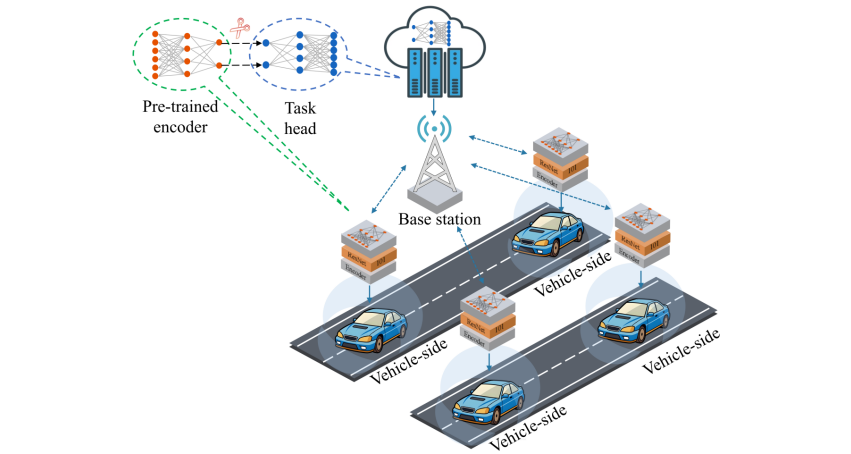
Federated learning (FL) has wide applications in the internet of vehicles (IoV), but it requires vehicles to perform local training and upload complete model parameters, resulting in heavy communication overhead. To address this issue, this paper proposes a semantic communication-assisted FL (SeFL), which reduces communication overhead by uploading semantic features instead of model parameters. Particularly, the vehicle side employs pre-trained encoders to extract and transmit features, while the server aggregates features for centralized task head training. Moreover, SeFL mitigates the negative impact of non-independent and identically distributed (non-IID) data on model performance through the server centralized training, which aggregates multi-source semantic features to reconstruct global data distribution. Besides, SeFL treats delayed semantic features as new samples participating in iterations, effectively avoiding convergence instability caused by outdated parameter aggregation. Experimental results demonstrate that when using ResNet-101 as the backbone network with a per-round aggregation time threshold (Tthreshold) of 1.0 s, SeFL achieves classification accuracy improvements of about 8.8% and 18.0% compared to traditional FL (TFL) and hierarchical FL (HFL), respectively. SeFL also reduces total communication overhead by about 99.2% and 98.5% compared to TFL and HFL, respectively. It also shows that when the Tthreshold is decreased from 1.0 s to 0.3 s, SeFL maintains relatively stable accuracy while TFL accuracy drops by approximately 28.9%.
Downloads
References
[1] Contreras-Castillo, J., Zeadally, S., Guerrero-Ibañez, J.A.: Internet of vehicles: architecture, protocols, and security. IEEE Internet of Things Journal 5(5), 3701–3709 (2018). https://doi.org/10.1109/JIOT.2017.2690901 DOI: https://doi.org/10.1109/JIOT.2017.2690902
[2] Fadhil, J.A., Sarhan, Q.I.: Internet of vehicles (IoV): a survey of challenges and solutions. In Proceedings of the 21st International Arab Conference on Information Technology (ACIT), pp. 1–10 (2020). https://doi.org/10.1109/ACIT50332.2020.9300097 DOI: https://doi.org/10.1109/ACIT50332.2020.9300095
[3] Kiran, B.R., Sobh, I., Talpaert, V., Mannion, P., Sallab, A.A.A., Yogamani, S., Perez, P.: Deep reinforcement learning for autonomous driving: a survey. IEEE Transactions on Intelligent Transportation Systems 23(6), 4909–4926 (2022). https://doi.org/10.1109/TITS.2021.3054625 DOI: https://doi.org/10.1109/TITS.2021.3054625
[4] Kuutti, S., Bowden, R., Jin, Y., Barber, P., Fallah, S.: A survey of deep learning applications to autonomous vehicle control. IEEE Transactions on Intelligent Transportation Systems 22(2), 712–733 (2021). https://doi.org/10.1109/TITS.2019.2962338 DOI: https://doi.org/10.1109/TITS.2019.2962338
[5] Grigorescu, S., Trasnea, B., Cocias, T., Macesanu, G.: A survey of deep learning techniques for autonomous driving. Journal of Field Robotics 37(3), 362–386 (2020). https://doi.org/10.1002/rob.21918 DOI: https://doi.org/10.1002/rob.21918
[6] Huang, Y., Du, J., Yang, Z., Zhou, Z., Zhang, L., Chen, H.: A survey on trajectory-prediction methods for autonomous driving. IEEE Transactions on Intelligent Vehicles 7(3), 652–674 (2022). https://doi.org/10.1109/TIV.2022.3167103 DOI: https://doi.org/10.1109/TIV.2022.3167103
[7] Zhang, P., Wang, G., Chen, S., Yu, Y., Chen, L.: The application of mobile edge computing in the space-air-ground integrated network. Journal of Intelligent Computing and Networking 1(1), 71–97 (2025). https://doi.org/10.64509/jicn.11.13 DOI: https://doi.org/10.64509/jicn.11.13
[8] Abboud, K., Omar, H.A., Zhuang, W.: Interworking of DSRC and cellular network technologies for V2X communications: a survey. IEEE Transactions on Vehicular Technology 65(12), 9457–9470 (2016). https://doi.org/10.1109/TVT.2016.2591558 DOI: https://doi.org/10.1109/TVT.2016.2591558
[9] Moradi-Pari, E., Tian, D., Bahramgiri, M., Rajab, S., Bai, S.: DSRC versus LTE-V2X: empirical performance analysis of direct vehicular communication technologies. IEEE Transactions on Intelligent Transportation Systems 24(5), 4889–4903 (2023). https://doi.org/10.1109/TITS.2023.3247339 DOI: https://doi.org/10.1109/TITS.2023.3247339
[10] Zadobrischi, E., Havriliuc, S.: Enhancing scalability of C-V2X and DSRC vehicular communication protocols with LoRa 2.4 GHz in the scenario of urban traffic systems. Electronics 13(14), 2845 (2024). https://doi.org/10.3390/electronics13142845 DOI: https://doi.org/10.3390/electronics13142845
[11] Yang, Z., Cheng, C., Li, Z., Wang, R., Zhang, X.: Reliable federated learning based on delayed gradient aggregation for intelligent connected vehicles. Engineering Applications of Artificial Intelligence 140, 109719 (2025). https://doi.org/10.1016/j.engappai.2024.109719 DOI: https://doi.org/10.1016/j.engappai.2024.109719
[12] Chellapandi, V.P., Yuan, L., Brinton, C.G., Zak, S.H., Wang, Z.: Federated learning for connected and automated vehicles: a survey of existing approaches and challenges. IEEE Transactions on Intelligent Vehicles 9(1), 119–137 (2024). https://doi.org/10.1109/TIV.2023.3332675 DOI: https://doi.org/10.1109/TIV.2023.3332675
[13] Almanifi, O.R.A., Chow, C.-O., Tham, M.-L., Chuah, J.H., Kanesan, J.: Communication and computation efficiency in federated learning: a survey. Internet of Things 22, 100742 (2023). https://doi.org/10.1016/j.iot.2023.100742 DOI: https://doi.org/10.1016/j.iot.2023.100742
[14] Chen, M., Poor, H.V., Saad, W., Cui, S.: Convergence time optimization for federated learning over wireless networks. IEEE Transactions on Wireless Communications 20(4), 2457–2471 (2021). https://doi.org/10.1109/TWC.2020.3042530 DOI: https://doi.org/10.1109/TWC.2020.3042530
[15] Dinh, C.T., Tran, N.H., Nguyen, M.N.H., Hong, C.S., Bao, W., Zomaya, A.Y., Gramoli, V.: Federated learning over wireless networks: convergence analysis and resource allocation. IEEE/ACM Transactions on Networking 29(1), 398–409 (2021). https://doi.org/10.1109/TNET.2020.3035770 DOI: https://doi.org/10.1109/TNET.2020.3035770
[16] Zhu, L., Lin, H., Lu, Y., Lin, Y., Han, S.: Delayed gradient averaging: tolerate the communication latency for federated learning. In Proceedings of the 35th International Conference on Neural Information Processing System, pp. 29995–30007 (2021)
[17] Chen, M., Mao, B., Ma, T.: FedSA: a staleness-aware asynchronous federated learning algorithm with non-IID data. Future Generation Computer Systems 120, 1–12 (2021). https://doi.org/10.1016/j.future.2021.02.012 DOI: https://doi.org/10.1016/j.future.2021.02.012
[18] Qiang, X., Chang, Z., Ye, C., Hamalainen, T., Min, G.: Split federated learning empowered vehicular edge intelligence: concept, adaptive design, and future directions. IEEE Wireless Communications 32(4), 90–97 (2025). https://doi.org/10.1109/MWC.009.2400219 DOI: https://doi.org/10.1109/MWC.009.2400219
[19] Zhao, Y., Li, M., Lai, L., Suda, N., Civin, D., Chandra, V.: Federated learning with non-IID data. arXiv preprint arXiv:1806.00582 (2018). https://doi.org/10.48550/arXiv.1806.00582
[20] Mao, J., Xiong, K., Liu, M., Qin, Z., Chen, W., Fan, P., Letaief, K.B.: A GAN-based semantic communication for text without CSI. IEEE Transactions on Wireless Communications 23(10), 14498–14514 (2024). https://doi.org/10.1109/TWC.2024.3415363 DOI: https://doi.org/10.1109/TWC.2024.3415363
[21] Xie, H., Qin, Z., Li, G.Y., Juang, B.-H.: Deep learning enabled semantic communication systems. IEEE Transactions on Signal Processing 69, 2663–2675 (2021). https://doi.org/10.1109/TSP.2021.3071210 DOI: https://doi.org/10.1109/TSP.2021.3071210
[22] Zhang, R., Xiong, K., Du, H., Niyato, D., Kang, J., Shen, X., Poor, H.V.: Generative AI-enabled vehicular networks: fundamentals, framework, and case study. IEEE Network 38(4), 259–267 (2024). https://doi.org/10.1109/MNET.2024.3391767 DOI: https://doi.org/10.1109/MNET.2024.3391767
[23] Zheng, G., Ni, Q., Navaie, K., Pervaiz, H., Zarakovitis, C.: A distributed learning architecture for semantic communication in autonomous driving networks for task offloading. IEEE Communications Magazine 61(11), 64–68 (2023). https://doi.org/10.1109/MCOM.002.2200765 DOI: https://doi.org/10.1109/MCOM.002.2200765
[24] Liu, J., Lu, Y., Wu, H., Dai, Y.: Efficient resource allocation and semantic extraction for federated learning empowered vehicular semantic communication. In Proceedings of the IEEE 98th Vehicular Technology Conference (VTC-Fall), pp. 1–5 (2023). https://doi.org/10.1109/VTC2023-Fall60731.2023.10333738 DOI: https://doi.org/10.1109/VTC2023-Fall60731.2023.10333738
[25] Xiong, K., Zhang, Y., Fan, P., Yang, H.-C., Zhou, X.: Mobile service amount based link scheduling for high-mobility cooperative vehicular networks. IEEE Transactions on Vehicular Technology 66(10), 9521–9533 (2017). https://doi.org/10.1109/TVT.2017.2714863 DOI: https://doi.org/10.1109/TVT.2017.2714863
[26] Zheng, G., Ni, Q., Navaie, K., Pervaiz, H., Min, G., Kaushik, A., Zarakovitis, C.: Mobility-aware split-federated learning with transfer learning for vehicular semantic communication networks. IEEE Internet of Things Journal 11(10), 17237–17248 (2024). https://doi.org/10.1109/JIOT.2024.3360230 DOI: https://doi.org/10.1109/JIOT.2024.3360230
[27] Sang, Z., Meng, C., Yan, W., Gao, B., Xiong, K., Fan, P.: Joint aggregation node selection and power adjustment for federated learning in IoV. In Proceedings of the 5th International Conference on Computer, Control and Robotics (ICCCR), pp. 438–433 (2025). https://doi.org/10.1109/ICCCR65461.2025.1107266 DOI: https://doi.org/10.1109/ICCCR65461.2025.11072661
[28] Paragliola, G.: Evaluation of the trade-off between performance and communication costs in federated learning scenario. Future Generation Computer Systems 136, 282–293 (2022). https://doi.org/10.1016/j.future.2022.06.006 DOI: https://doi.org/10.1016/j.future.2022.06.006
[29] McMahan, B., Moore, E., Ramage, D., Hampson, S., Arcas, B.A.y.: Communication-efficient learning of deep networks from decentralized data. In Proceedings of the 20th International Conference on Artificial Intelligence and Statistics (AISTATS), pp. 1273–1282 (2017)
[30] Zeiler, M.D., Fergus, R.: Visualizing and understanding convolutional networks. In Proceedings of the European Conference on Computer Vision (ECCV), pp. 818–833 (2014). https://doi.org/10.1007/978-3-319-10590-1_53 DOI: https://doi.org/10.1007/978-3-319-10590-1_53
[31] Sharif Razavian, A., Azizpour, H., Sullivan, J., Carlsson, S.: CNN features off-the-shelf: an astounding baseline for recognition. In Proceedings of the IEEE Conference on Computer Vision and Pattern Recognition Workshops, pp. 512–519 (2014). https://doi.org/10.1109/CVPRW.2014.131 DOI: https://doi.org/10.1109/CVPRW.2014.131
[32] Yosinski, J., Clune, J., Bengio, Y., Lipson, H.: How transferable are features in deep neural networks? In Advances in Neural Information Processing Systems 27, pp. 1–9 (2014)
[33] Lu, F., Zhu, K., Zhai, W., Cao, Y., Zha, Z.-J.: Likelihood-aware semantic alignment for full-spectrum out-of-distribution detection. Journal of Intelligent Computing and Networking 1(1), 1–13 (2025). https://doi.org/10.64509/jicn.11.10 DOI: https://doi.org/10.64509/jicn.11.10
[34] Molisch, A.F., Tufvesson, F., Karedal, J., Mecklenbrauker, C.F.: A survey on vehicle-to-vehicle propagation channels. IEEE Wireless Communications 16(6), 12–22 (2009). https://doi.org/10.1109/MWC.2009.5361174 DOI: https://doi.org/10.1109/MWC.2009.5361174
[35] Wu, D., Negi, R.: Effective capacity: a wireless link model for support of quality of service. IEEE Transactions on Wireless Communications 2(4), 630–643 (2003). https://doi.org/10.1109/TWC.2003.814353 DOI: https://doi.org/10.1109/TWC.2003.814353
[36] 3GPP: Study on channel model for frequencies from 0.5 to 100 GHz. Technical Report TR 38.901 (Release 16), 3rd Generation Partnership Project (2020)
[37] Boban, M., Vinhoza, T.T.V., Ferreira, M., Barros, J., Tonguz, O.K.: Impact of vehicles as obstacles in vehicular ad hoc networks. IEEE Journal on Selected Areas in Communications 29(1), 15–28 (2011). https://doi.org/10.1109/JSAC.2011.110103 DOI: https://doi.org/10.1109/JSAC.2011.110103
[38] Ho, Q., Cipar, J., Cui, H., Lee, S., Kim, J.K., Gibbons, P.B., Gibson, G.A., Xing, E.P.: More effective distributed ML via a stale synchronous parallel parameter server. In Proceedings of the 27th International Conference on Neural Information Processing Systems, pp. 1223–1231 (2013)
[39] Karagiannis, G., Altintas, O., Ekici, E., Heijenk, G., Jarupan, B., Lin, K., Weil, T.: Vehicular networking: a survey and tutorial on requirements, architectures, challenges, standards and solutions. IEEE Communications Surveys & Tutorials 13(4), 584–616 (2011). https://doi.org/10.1109/SURV.2011.061411.00019 DOI: https://doi.org/10.1109/SURV.2011.061411.00019
[40] Xiang, W., Gozalvez, J., Niu, Z., Altintas, O., Ekici, E.: Wireless access in vehicular environments. Journal on Wireless Communications and Networking 2009, 576217 (2009). https://doi.org/10.1155/2009/576217 DOI: https://doi.org/10.1155/2009/576217
[41] Slomson, A.B.: Introduction to combinatorics. Chapman and Hall/CRC Press, Boca Raton, FL, USA (1997)
[42] Stallkamp, J., Schlipsing, M., Salmen, J., Igel, C.: The German Traffic Sign Recognition Benchmark: a multi-class classification competition. In Proceedings of the International Joint Conference on Neural Networks (IJCNN), pp. 1453–1460 (2011). https://doi.org/10.1109/IJCNN.2011.6033395 DOI: https://doi.org/10.1109/IJCNN.2011.6033395
[43] TorchVision: PyTorch’s computer vision library. https://github.com/pytorch/vision Accessed: 2025-09-17
[44] He, K., Zhang, X., Ren, S., Sun, J.: Deep residual learning for image recognition. In Proceedings of the IEEE Conference on Computer Vision and Pattern Recognition (CVPR), pp. 770–778 (2016). https://doi.org/10.1109/CVPR.2016.90 DOI: https://doi.org/10.1109/CVPR.2016.90
Downloads
Published
Issue
Section
License
Copyright (c) 2026 Authors

This work is licensed under a Creative Commons Attribution 4.0 International License.
How to Cite