
Cross-Domain Collaborative Federated Intelligence for Wireless Computing Power Networks
DOI:
https://doi.org/10.64509/jicn.21.75Keywords:
Cross-Domain Collaborative, Federated Learning, Resource Orchestration, Wireless Computing Power networksAbstract
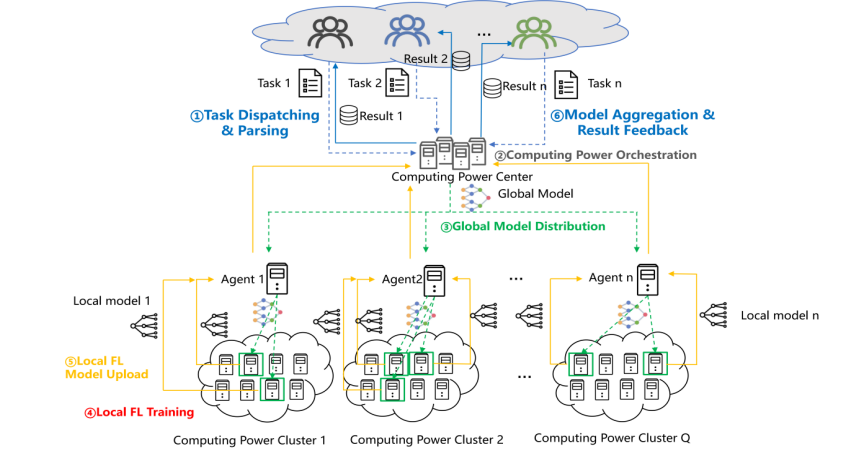
With the rapid development of wireless and intelligent computing technologies, emerging applications like autonomous driving and AI agents demand ubiquitous, low-latency, and efficient computing resources. Wireless computing power networks (WCPNs), which interconnect geographically distributed and heterogeneous computing nodes through wireless communication infrastructures, are regarded as a key paradigm for supporting such computing-intensive and latency-sensitive services. However, the current critical challenge is how to achieve efficient, low-latency joint optimisation across domains and multiple tasks by coordinating highly heterogeneous distributed computing and communication resources while protecting each node's data privacy. To address the challenge of privacy-preserving collaboration among heterogeneous computing nodes with non-IID data distributions in WCPNs, this paper introduces a federated intelligence–driven learning framework. By leveraging federated learning with a FedOpt-based aggregation mechanism, collaborative model training can be achieved without sharing raw data, while improving accuracy and convergence performance under data and node heterogeneity. To further address the cross-domain multi-task resource allocation problem under stringent real-time requirements, a joint optimisation model is formulated that incorporates wireless communication conditions, heterogeneous computing capabilities, task service demands, and system energy consumption. By minimising the total execution delay of multiple tasks subject to resource, energy, and scheduling constraints, a genetic algorithm–based solution is employed to derive near-optimal task orchestration and resource allocation strategies. Simulation results demonstrate that the proposed framework achieves lower task execution delay and higher energy efficiency than baseline schemes, validating its effectiveness in WCPNs.
Downloads
References
[1] Chowdhury, M.Z., Shahjalal, M., Ahmed, S., Jang, Y.M.: 6G Wireless Communication Systems: Applications, Requirements, Technologies, Challenges, and Research Directions. IEEE Open Journal of the Communications Society 1, 957–975 (2020). https://doi.org/10.1109/OJCOMS.2020.3010270
[2] Yang, H., Alphones, A., Xiong, Z., Niyato, D., Zhao, J., Wu, K.: Artificial-Intelligence-Enabled Intelligent 6G Networks. IEEE Network 34(6), 272–280 (2020). https://doi.org/10.1109/MNET.011.2000195
[3] Deng, Z., Guo, Y., Han, C., Ma, W., Xiong, J., Wen, S., Xiang, Y.: AI Agents Under Threat: A Survey of Key Security Challenges and Future Pathways. ACM Computing Surveys 57(7), 1–36 (2025). https://doi.org/10.1145/3716628
[4] Sun, W., Lin, X., Shi, Y., Zhang, C., Wu, H., Zheng, S.: SparseDrive: End-to-End Autonomous Driving via Sparse Scene Representation. In 2025 IEEE International Conference on Robotics and Automation (ICRA), pp. 8795–8801 (2025). https://doi.org/10.1109/ICRA55743.2025.11128800
[5] Alhakamy, A.A.: Extended Reality (XR) Toward Building Immersive Solutions: The Key to Unlocking Industry 4.0. ACM Computing Surveys 56(9), 1–38 (2024). https://doi.org/10.1145/3652595
[6] May, M.C., Glatter, D., Arnold, D., Pfeffer, D., Lanza, G.: IIoT System Canvas-From architecture patterns towards an IIoT development framework. Journal of Manufacturing Systems 72, 437–459 (2024). https://doi.org/10.1016/j.jmsy.2023.12.001
[7] Liu, J., Lu, Y., Wu, H., Ai, B., Jamalipour, A., Zhang, Y.: Joint Task Coding and Transfer Optimization for Edge Computing Power Networks. IEEE Transactions on Network Science and Engineering 12(4), 2783–27962 (2025). https://doi.org/10.1109/TNSE.2025.3554100
[8] Shen, H., Lu, Y., Li, H., Zhao, W., Feng, Y., Yuan, Y.: Reliable Federated Learning-Based Wireless Computing Power Scheduling for Efficient Edge Computing Networks. In 2024 IEEE 24th International Conference on Communication Technology (ICCT), pp. 168–173 (2024). https://doi.org/10.1109/ICCT62411.2024.10946361
[9] Teng, F., Ban, Z., Li, T., Sun, Q., Li, Y.: A privacy-preserving distributed economic dispatch method for integrated port microgrid and computing power network. IEEE Transactions on Industrial Informatics 20(8), 10103–10112 (2024). https://doi.org/10.1109/TII.2024.3393569
[10] Lu, Z., Pan, H., Dai, Y., Si, X., Zhang, Y.: Federated learning with non-iid data: A survey. IEEE Internet of Things Journal 11(11), 19188–19209 (2024). https://doi.org/10.1109/JIOT.2024.3376548
[11] Qin, K., Gu, S., Zhang, Z., Zhang, Q., Xiang, W.: Relay Selection and Load Allocation for LT Coded Distributed Computing in Two-Hop Heterogeneous Computation Network. In 2024 IEEE Wireless Communications and Networking Conference (WCNC), pp. 1–6 (2024). https://doi.org/10.1109/WCNC57260.2024.10571074
[12] Gecer, M., Garbinato, B.: Federated learning for mobility applications. ACM Computing Surveys 56(5), 1–28 (2024). https://doi.org/10.1145/3637868
[13] Zhou, Y., Ye, Q., Lv, J.: Communication-efficient federated learning with compensated overlap-fedavg. IEEE Transactions on Parallel and Distributed Systems 33(1), 192–205 (2021). https://doi.org/10.1109/TPDS.2021.3090331
[14] Lee, H., Lee, S.H., Quek, T.Q.: Deep learning for distributed optimization: Applications to wireless resource management. IEEE Journal on Selected Areas in Communications, 37(10), 2251–2266 (2019). https://doi.org/10.1109/JSAC.2019.2933890
[15] Liu, Y., Zhang, W., Zhang, Q., Norouzi, M.: An optimized human resource management model for cloudedge computing in the internet of things. Cluster Computing 25(4), 2527–2539 (2022). https://doi.org/10.1007/s10586-021-03319-y
[16] Hussain, F., Hassan, S.A., Hussain, R., Hossain, E.: Machine learning for resource management in cellular and IoT networks: Potentials, current solutions, and open challenges. IEEE communications surveys & tutorials 22(2), 1251–1275 (2020). https://doi.org/10.1109/COMST.2020.2964534
[17] Shen, Y., Shi, Y., Zhang, J., Letaief, K.B.: Graph neural networks for scalable radio resource management: Architecture design and theoretical analysis. IEEE Journal on Selected Areas in Communications 39(1), 101–115 (2020). https://doi.org/10.1109/JSAC.2020.3036965
[18] Xiang, X., Li, Q., Khan, S., Khalaf, O.I.: Urban water resource management for sustainable environment planning using artificial intelligence techniques. Environmental impact assessment review 86, 106515 (2021). https://doi.org/10.1016/j.eiar.2020.106515
[19] Xia, S., Yao, Z., Li, Y., Mao, S.: Online distributed offloading and computing resource management with energy harvesting for heterogeneous MEC-enabled IoT. IEEE Transactions on Wireless Communications 20(10), 6743–6757 (2021). https://doi.org/10.1109/TWC.2021.3076201
[20] Asad, M., Moustafa, A., Ito, T.: Fedopt: Towards communication efficiency and privacy preservation in federated learning. Applied Sciences 10(8), 2864 (2020). https://doi.org/10.3390/app10082864
[21] Li, L., Fan, Y., Tse, M., Lin, K. Y.: A review of applications in federated learning. Computers & Industrial Engineering 149, 106854 (2020). https://doi.org/10.1016/j.cie.2020.106854
[22] Ma, X., Zhu, J., Lin, Z., Chen, S., Qin, Y.: A state-of-the-art survey on solving non-iid data in federated learning. Future Generation Computer Systems 135, 244–258 (2022). https://doi.org/10.1016/j.future.2022.05.003
[23] Zhou, Y., Shi, M., Tian, Y., Li, Y., Ye, Q., Lv, J.: Federated CINN clustering for accurate clustered federated learning. In ICASSP 2024-2024 IEEE International Conference on Acoustics, Speech and Signal Processing (ICASSP), pp. 5590–5594 (2024). https://doi.org/10.1109/ICASSP48485.2024.10447282
[24] Gao, T., Liu, K., Yang, Y., Liu, X., Zhang, P., Wang, G.: FedPC: An Efficient Prototype-Based Clustered Federated Learning on Medical Imaging. IEEE Journal of Biomedical and Health Informatics 29(10), 7396–7408 (2025). https://doi.org/10.1109/JBHI.2025.3567055
[25] Pillutla, K., Kakade, S. M., Harchaoui, Z.: Robust aggregation for federated learning. IEEE Transactions on Signal Processing 70, 1142–1154 (2022). https://doi.org/10.1109/TSP.2022.3153135
[26] Hu, C., Wang, S., Liu, C., Zhang, T.: Efficient privacy-preserving data aggregation for lightweight secure model training in federated learning. In 2023 7th International Conference on Cryptography, Security and Privacy (CSP), pp. 119–123 (2023). https://doi.org/10.1109/CSP58884.2023.00026
[27] Tan, K., Feng, L., D´an, G., T¨orngren, M.: Decentralized convex optimization for joint task offloading and resource allocation of vehicular edge computing systems. IEEE Transactions on Vehicular Technology 71(12), 13226–13241 (2022). https://doi.org/10.1109/TVT.2022.3197627
[28] Chen, Y., Yang, Y., Wu, Y., Huang, J., Zhao, L.: Joint trajectory optimization and resource allocation in UAVMEC systems: A Lyapunov-assisted DRL approach. IEEE Transactions on Services Computing 18(2), 854–867 (2025). https://doi.org/10.1109/TSC.2025.3544124
[29] Jalali, J., Tabassum, H., Famaey, J., Saad, W., Uysal, M.: Placement, Orientation, and Resource Allocation Optimization for Cell-Free OIRS-Aided OWC Network. IEEE Transactions on Vehicular Technology 74(6), 10011–10016 (2025). https://doi.org/10.1109/TVT.2025.3538334
[30] Min, H., Rahmani, A.M., Ghaderkourehpaz, P., Moghaddasi, K., Hosseinzadeh, M.: A joint optimization of resource allocation management and multi-task offloading in high-mobility vehicular multi-access edge computing networks. Ad Hoc Networks 166, 103656 (2025). https://doi.org/10.1016/j.adhoc.2024.103656
[31] Jie, Y., Guo, C., Choo, K.K.R., Liu, C.Z., Li, M.: Game-theoretic resource allocation for fog-based industrial internet of things environment. IEEE Internet of Things Journal 7(4), 3041–3052 (2020). https://doi.org/10.1109/JIOT.2020.2964590
[32] Wang, Y., Yang, X.: Intelligent resource allocation optimization for cloud computing via machine learning. arXiv preprint arXiv:2504.03682 (2025). https://doi.org/10.48550/arXiv.2504.03682
[33] Lambora, A., Gupta, K., Chopra, K.: Genetic algorithmA literature review. In 2019 international conference on machine learning, big data, cloud and parallel computing (COMITCon), pp. 380–384 (2019). https://doi.org/10.1109/COMITCon.2019.8862255
Downloads
Published
Issue
Section
License
Copyright (c) 2026 Authors

This work is licensed under a Creative Commons Attribution 4.0 International License.
How to Cite