
RGF-Net: A Dual-Stream Spatiotemporal Fusion Network for Robust Automatic Modulation Recognition in Cognitive Radio
DOI:
https://doi.org/10.64509/jicn.21.95Keywords:
Automatic Modulation Recognition, Deep Learning, Model Fusion, Residual Networks, Decision FusionAbstract
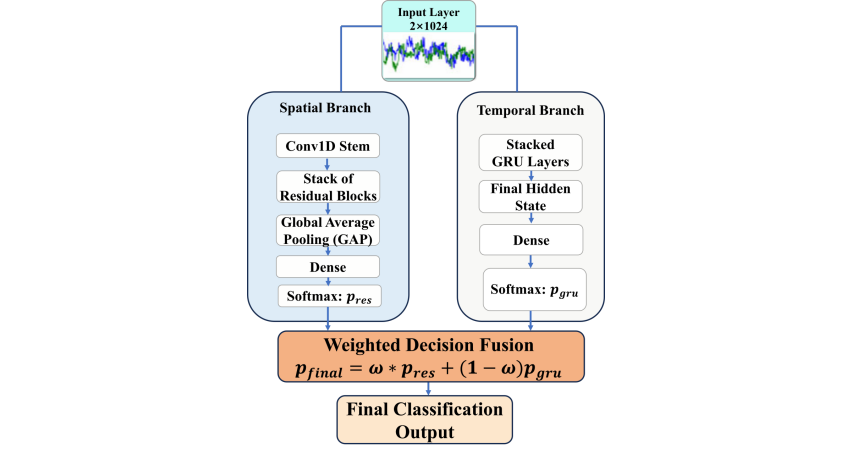
Automatic Modulation Recognition (AMR) is an enabling component of cognitive radio because it helps secondary users infer incumbent transmission formats under limited prior information. Existing single-stream deep networks often emphasize either spatial constellation structure or temporal evolution, which can reduce robustness under noisy channel conditions. This paper presents RGF-Net, a dual-stream framework that processes the same raw I/Q sequence with a ResNet branch and a GRU branch, then combines their class-posterior outputs through a learnable decision-fusion weight. The methodological contribution therefore lies in the parallel decomposition and end-to-end calibration of complementary spatial and temporal classifiers, rather than in proposing a new backbone block. Experiments on the synthetic RadioML2018.10a benchmark show that, among the compared models, RGF-Net achieves the highest accuracy across the evaluated SNR range and improves the 0 dB accuracy by 12.2 percentage points over the strongest single-branch baseline. These results indicate that the proposed fusion design is effective on this benchmark, while evaluation on additional real-world datasets remains necessary.
Downloads
References
[1] Akyildiz, I.F., Lee, W.-Y., Vuran, M.C., Mohanty, S.: Next generation/dynamic spectrum access/cognitive radio wireless networks: A survey. Computer Networks 50(13), 2127-2159 (2006). https://doi.org/10.1016/j.comnet.2006.05.001
[2] Zhang, P., Wang, G., Chen, S., Yu, Y., Chen, L.: The application of mobile edge computing in the space-air-ground integrated network. Journal of Intelligent Computing and Networking 1(1), 71-97 (2025). https://doi.org/10.64509/jicn.11.13
[3] Mitola III, J.: Cognitive radio: An integrated agent architecture for software defined radio. PhD Thesis, KTH Royal Institute of Technology (2000).
[4] Luo, M., Mao, J., Xiong, G., Luo, M., Mao, J., Xiong, G., Anjum, M.R.: A semantic communication-assisted federated learning framework for Internet of Vehicles. Journal of Intelligent Computing and Networking 2(1), 55-69 (2026). https://doi.org/10.64509/jicn.21.74
[5] Yucek, T., Arslan, H.: A survey of spectrum sensing algorithms for cognitive radio applications. IEEE Communications Surveys & Tutorials 11(1), 116-130 (2009). https://doi.org/10.1109/SURV.2009.090109
[6] Dobre, O.A., Abdi, A., Bar-Ness, Y., Su, W.: Survey of automatic modulation classification techniques: Classical approaches and new trends. IET Communications 1(2), 137-156 (2007). https://doi.org/10.1049/iet-com:20050176
[7] Augustine, Z., Alabi, C., Njoku, F.C., Imoize, A.L., Raymond, J.: Throughput optimization using spectrum sensing vertical hypotheses integrated with F-OFDM technique. Journal of Intelligent Computing and Networking 2(1), 1-12 (2026). https://doi.org/10.64509/jicn.21.50
[8] Huang, S., Jiang, Y., Gao, Y., Feng, Z., Zhang, P.: Automatic modulation classification using contrastive fully convolutional network. IEEE Wireless Communications Letters 8(4), 1044-1047 (2019). https://doi.org/10.1109/LWC.2019.2904956
[9] Wei, W., Mendel, J.M.: Maximum-likelihood classification for digital amplitude-phase modulations. IEEE Transactions on Communications 48(2), 189-193 (2000). https://doi.org/10.1109/26.823550
[10] Gardner, W.A.: Signal interception: A unifying theoretical framework for feature detection. IEEE Transactions on Communications 36(8), 897-906 (1988). https://doi.org/10.1109/26.3769
[11] O'Shea, T., Corgan, J.: Convolutional radio modulation recognition networks. In International Conference on Engineering Applications of Neural Networks (EANN), pp. 213-226 (2016). https://doi.org/10.1007/978-3-319-44188-7_16
[12] Wang, Y., Liu, M., Yang, J., Gui, G.: Data-driven deep learning for automatic modulation recognition in cognitive radios. IEEE Transactions on Vehicular Technology 68(4), 4074-4077 (2019). https://doi.org/10.1109/TVT.2019.2900460
[13] Rajendran, S., Meert, W., Giustiniano, D., Lenders, V., Pollin, S.: Deep learning models for wireless signal classification with distributed low-cost spectrum sensors. IEEE Transactions on Cognitive Communications and Networking 4(3), 433-445 (2018). https://doi.org/10.1109/TCCN.2018.2835460
[14] Zhou, Q., Jing, X., He, Y., Cui, Y., Kadoch, M., Cheriet, M.: LSTM-based automatic modulation classification. In 2020 IEEE International Symposium on Broadband Multimedia Systems and Broadcasting (BMSB), pp. 1-4 (2020). https://doi.org/10.1109/BMSB49480.2020.9379677
[15] Sainath, T.N., Vinyals, O., Senior, A., Sak, H.: Convolutional, long short-term memory, fully connected deep neural networks. In Proceedings of the IEEE International Conference on Acoustics, Speech and Signal Processing (ICASSP), pp. 4580-4584 (2015). https://doi.org/10.1109/ICASSP.2015.7178838
[16] Polikar, R.: Ensemble based systems in decision making. IEEE Circuits and Systems Magazine 6(3), 21-45 (2006). https://doi.org/10.1109/MCAS.2006.1688199
[17] Karpathy, A., Toderici, G., Shetty, S., Leung, T., Sukthankar, R., Fei-Fei, L.: Large-scale video classification with convolutional neural networks. In Proceedings of the IEEE Conference on Computer Vision and Pattern Recognition (CVPR), pp. 1725-1732 (2014). https://doi.org/10.1109/CVPR.2014.223
[18] Kittler, J., Hatef, M., Duin, R.P.W., Matas, J.: On combining classifiers. IEEE Transactions on Pattern Analysis and Machine Intelligence 20(3), 226-239 (1998). https://doi.org/10.1109/34.667881
[19] Swami, A., Sadler, B.M.: Hierarchical digital modulation classification using cumulants. IEEE Transactions on Communications 48(3), 416-429 (2000). https://doi.org/10.1109/26.837045
[20] He, K., Zhang, X., Ren, S., Sun, J.: Deep residual learning for image recognition. In Proceedings of the IEEE Conference on Computer Vision and Pattern Recognition (CVPR), pp. 770-778 (2016). https://doi.org/10.1109/CVPR.2016.90
[21] West, N.E., O'Shea, T.: Deep architectures for modulation recognition. In: IEEE International Symposium on Dynamic Spectrum Access Networks (DySPAN), pp. 1-6 (2017). https://doi.org/10.1109/DySPAN.2017.7920754
[22] Cho, K., et al.: Learning phrase representations using RNN encoder-decoder for statistical machine translation. In Conference on Empirical Methods in Natural Language Processing (EMNLP), pp. 1724-1734 (2014). https://doi.org/10.3115/v1/D14-1179
[23] O'Shea, T., Roy, T., Clancy, T.C.: Over-the-air deep learning based radio signal classification. IEEE Journal of Selected Topics in Signal Processing 12(1), 168-179 (2018). https://doi.org/10.1109/JSTSP.2018.2797022
Downloads
Published
Issue
Section
License
Copyright (c) 2026 Authors

This work is licensed under a Creative Commons Attribution 4.0 International License.
How to Cite